The Bottleneck Is You: Why AI Makes Thinking Skills More Important
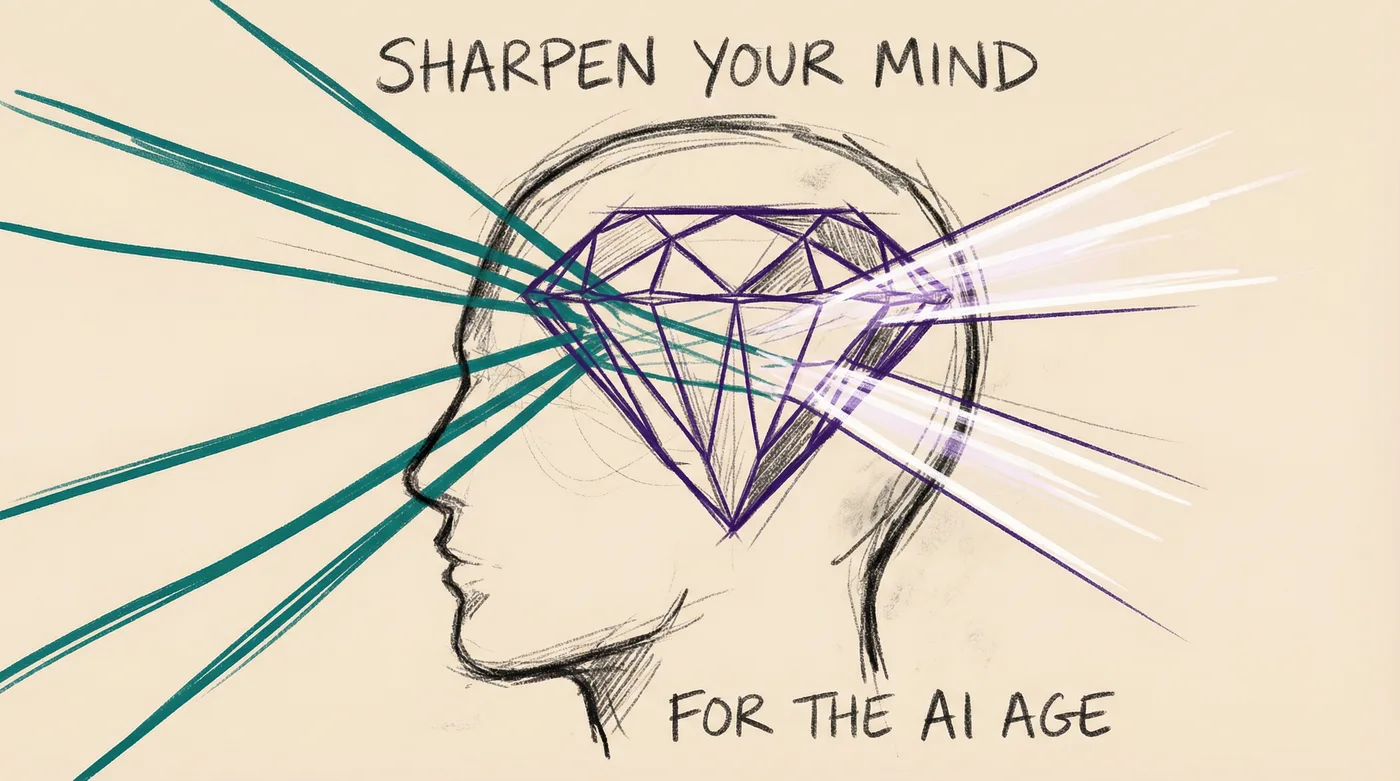
There’s a seductive idea floating around: now that AI can write, code, and reason, you don’t need to be that good at writing, coding, or reasoning yourself. Just describe what you want, and the machine handles the hard part.
This is exactly backwards.
The Actual Bottleneck
When you work with AI, something becomes painfully clear very quickly: the AI is not the limiting factor. The AI can generate code, prose, analysis, designs — faster than you can read them. It has near-infinite patience and encyclopedic knowledge.
The bottleneck is you.
Specifically: can you tell the AI what you actually want? Can you describe the problem precisely enough that the solution matches your intent? Can you specify the constraints, the edge cases, the implicit requirements that live in your head but never made it into words?
Most people can’t. Not because they’re stupid, but because they’ve never had to. Before AI, vague intentions got filtered through slow execution. You had time to figure out what you meant while you were doing it. Now the execution is instant, and your fuzzy thinking produces fuzzy results at machine speed.
You Can’t Say What You Can’t Think
Here’s the uncomfortable truth: your ability to instruct an AI is bounded by your ability to think clearly.
If you can’t hold a complex system in your head, you can’t describe it to an AI. If you don’t understand the distinctions between similar concepts, your instructions will be ambiguous. If you’ve never thought through the edge cases, you won’t know to mention them.
Language isn’t just how you communicate with AI — it’s how you think. The limits of your vocabulary are the limits of your mental models. The precision of your language reflects the precision of your understanding.
When someone struggles to get useful output from an AI, the problem is rarely the AI. It’s usually that they don’t actually know what they want. They have a vague sense, a fuzzy intention, a “I’ll know it when I see it” that no instruction can capture because no clear thought exists to capture.
The Paradox of AI Assistance
This creates a paradox that most people haven’t grasped yet:
The better AI gets at execution, the more valuable human thinking becomes.
When execution was hard, you could get by with mediocre ideas and good implementation. Plenty of successful products were obvious concepts executed well. The hard part was building, not conceiving.
Now execution is cheap. Anyone can spin up a prototype in hours. The differentiator shifts upstream — to the quality of the conception, the clarity of the specification, the depth of the requirements.
And where does that quality come from? From minds that have been trained to think precisely. From people who have wrestled with complex ideas until they understood them. From thinkers who can hold contradictions, see edge cases, anticipate failure modes — and articulate all of it in language clear enough for a machine to follow.
What Actually Sharpens Thinking
If clear thinking is the new bottleneck, how do you improve it? The answer isn’t AI tutors or productivity apps. It’s older than that.
Read. Not summaries. Not tweets. Books that make you work. Philosophy, history, technical texts that require you to build mental models chapter by chapter. Reading trains you to follow complex arguments, hold multiple ideas in tension, and integrate new concepts into existing frameworks. There’s no shortcut.
Reflect. Don’t just consume — process. What did that article actually argue? What were the weak points? How does it connect to what you already know? Journaling, note-taking, even just staring at the ceiling thinking — this is where ideas consolidate into understanding.
Thought experiment. Take an idea and push it. What if this were true in every case? What would break? What would the opposite look like? Thought experiments force you to explore the boundaries of concepts, which is exactly where the important distinctions live.
Communicate with humans. Explaining ideas to people is different from explaining to AI. People push back. They misunderstand in illuminating ways. They ask “why” when you expected “how.” Conversation — real conversation, not comments and threads — forces you to refine your thinking in real time.
Participate in communities. Find people who think about things you care about. Engage with their ideas. Argue. Be wrong publicly and learn from it. Communities create the friction that polishes rough thinking into sharp insight.
None of this is efficient. All of it is effective.
The Irony of the AI Age
Here’s what strikes me as deeply ironic: the skills that AI makes more valuable are exactly the skills that the last two decades of internet culture have eroded.
Deep reading? We optimized for skimming and hot takes. Sustained reflection? We filled every quiet moment with notifications. Complex argument? We reduced discourse to dunks and ratio counts. Community participation? We replaced it with parasocial relationships and echo chambers.
And now, just when execution becomes trivially cheap, we discover that the hard part was always conception — and we’ve spent twenty years degrading our capacity for it.
The people who will thrive in the AI age aren’t the ones who learn to prompt better. They’re the ones who never stopped reading books, never stopped engaging with hard ideas, never stopped having real conversations about complex things.
They were training for a race they didn’t know was coming.
The Meta-Skill
There’s a meta-skill underneath all of this: the ability to know what you don’t know.
When you instruct an AI, you need to understand where your understanding is weak. You need to recognize when your specification is incomplete, when your requirements are contradictory, when your mental model has gaps.
This is intellectual humility, and it comes from repeatedly being wrong and learning from it. It comes from engaging with ideas strong enough to show you your limits. It comes from communities that challenge your assumptions rather than validate them.
You can’t get this from AI. AI is trained to help you, not to show you where you’re confused. It’ll generate confident answers to confused questions, and you won’t know the difference unless you already have the framework to evaluate it.
The learning has to happen human-to-human, or human-to-text, in the messy inefficient way that actually updates mental models.
The Practical Upshot
So here’s the practical advice:
Read one hard book per month. Not self-help. Not summaries. Something that requires effort. Philosophy, dense history, technical depth outside your field. Your goal is to build new mental models, not collect information.
Write to think. Daily if possible. Not for publication — for clarification. When you force ideas into sentences, you discover what you actually understand versus what you’re just gesturing at.
Find a thinking community. Online or offline, find people who engage with ideas seriously. Participate. Argue. Change your mind when the argument is better than yours.
Talk to humans about hard things. Have dinner conversations that go past surface level. Explain your work to people outside your field. The friction of real-time communication is the friction that sharpens thought.
Use AI to execute, not to think. This is crucial. AI is an execution amplifier, not a thinking substitute. If you outsource the thinking, you outsource the only part that matters. Use AI to build what you’ve conceived — not to conceive for you.
The Uncomfortable Conclusion
The AI age isn’t going to be kind to intellectual laziness. For a while, it might look like everyone can fake competence — generate impressive-looking artifacts without understanding what they mean. But the gap between “looks right” and “is right” will eventually matter. Systems built on fuzzy thinking will fail in production. Strategies based on vibes will collapse when edge cases arrive.
The people who invested in their ability to think — who read the hard books, engaged with the hard communities, had the hard conversations — will be the ones who can actually specify what needs to be built. And specification is everything now.
Your brain is the prompt engineer. Train it accordingly.
Written after noticing that my best AI sessions correlate perfectly with topics I actually understand, and my worst sessions are exactly where my own thinking is muddiest.